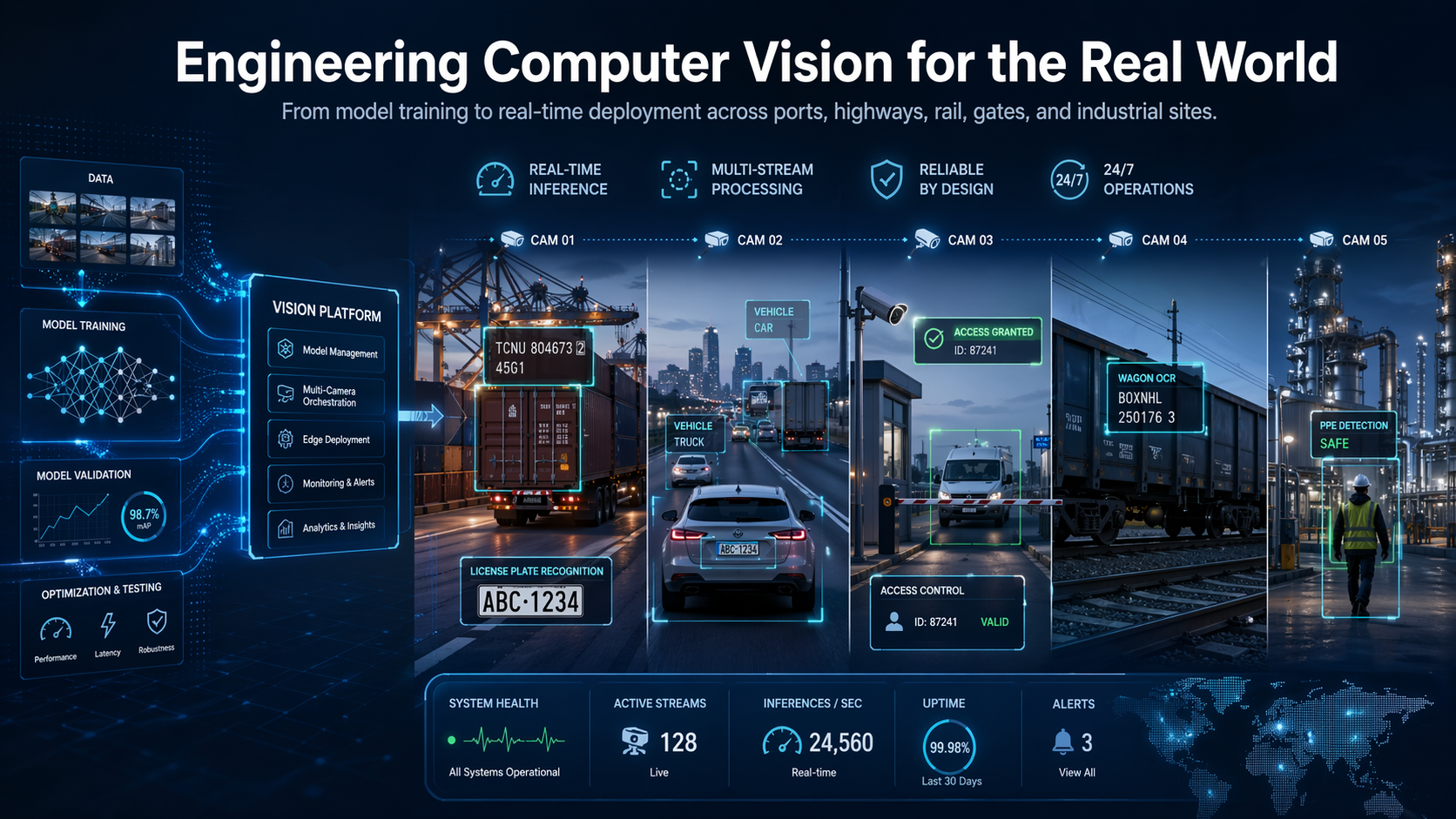
Engineering Computer Vision for the Real World
Training an accurate model is the easy part. Making it perform reliably, frame after frame, camera after camera, for years in the field — that’s where most computer vision projects quietly fall apart.
At Industrial Cortex, we build vision systems that work where it matters: at ports, on highways, at gates, along rail lines, and inside industrial facilities that can’t tolerate downtime or guesswork. License plate recognition, container and wagon code reading, vehicle make/model/color identification, OCR on moving objects — these aren’t lab demos for us. They’re production systems running 24/7 across multiple camera streams.
Getting there requires two things that are rarely found together: deep expertise in training models for hard industrial problems, and the engineering discipline to deploy them at real-world speed and scale.
The Real Asset: Knowing How to Train
In a world where pre-trained models are a download away, the differentiator is no longer access to AI — it’s knowing how to shape it to a specific problem.
Industrial vision is full of problems that generic models handle poorly. Container codes weathered by salt and sun. License plates at oblique angles and in a dozen national formats. Wagon numbers half-obscured by rust or graffiti. Vehicles photographed in rain, backlight, headlight glare, and everything in between. Off-the-shelf models don’t solve these problems. Purpose-trained ones do.
Our team’s core expertise is in that second category. We know how to build the datasets, design the augmentation strategies, select the architectures, structure the detection-plus-recognition pipelines, and run the evaluation loops that turn a promising prototype into a model that actually holds up in the field. This is years of accumulated know-how — the part of AI work that isn’t in any framework’s documentation, and the part that most determines whether a system succeeds.
This is our real asset. The models are the output. The expertise is what makes them good.
Runtime Is Where Products Are Won or Lost
A well-trained model is necessary, but not sufficient. A real OCR or recognition pipeline is never just “run the model.” It’s frame acquisition, buffering, preprocessing, detection, cropping, normalization, inference, decoding, validation, post-processing, tracking, event generation, logging, and delivery to whatever system consumes the result — all happening concurrently, across many cameras, without skipping a beat.
Every stage in that chain competes for CPU, GPU, memory bandwidth, and I/O. The difference between a system that holds 30 FPS across twelve streams and one that chokes at three is almost never the model itself. It’s the architecture around it.
That’s where we invest. Our runtime is designed for deterministic latency under load, efficient memory reuse across video pipelines, tight integration with industrial cameras and hardware accelerators, and predictable behavior during the long tail of real-world conditions — bad lighting, weather, occlusion, vibration, dirt, motion blur.
The result is a system that behaves the same way on day 400 as it did on day one.
What This Means for Our Customers
Accuracy benchmarks are table stakes. What separates a working deployment from a stalled pilot is everything that happens around the model:
Can it be trained for your specific conditions, sites, and edge cases? Can it run in real time on the hardware you already have? Can it scale from one camera to a hundred without a rewrite? Does it degrade gracefully when conditions get ugly? Can it be integrated with your existing SCADA, access control, TOS, or security platform without friction? Will it still be maintainable in three years?
These are the questions we engineer against. Not because they’re easy to answer, but because our customers — port operators, rail authorities, logistics companies, industrial sites, municipal systems — can’t afford systems that only work in ideal conditions.
The Bottom Line
Modern AI is no longer a differentiator on its own. Everyone has access to good models. What matters now is the expertise to train them for problems that actually matter, and the engineering discipline to deploy them in environments that don’t forgive shortcuts.
That’s what we do at Industrial Cortex.