
Plate Country Classification: The Context That Makes OCR Smarter
Reading a license plate is one problem. Knowing what country issued it is another — and in many deployments, the second problem quietly determines how well the first one gets solved.
A plate is not just a string of characters. It’s a visual object with structure: color layout, font choices, regional symbols, spacing conventions, and format rules that vary from country to country and sometimes from region to region within a country. A recognition engine that ignores those signals is throwing away information. A recognition engine that uses them performs measurably better.
That’s what Plate Country Classification adds to our ANPR pipeline: a layer of context that turns generic OCR into country-aware OCR.
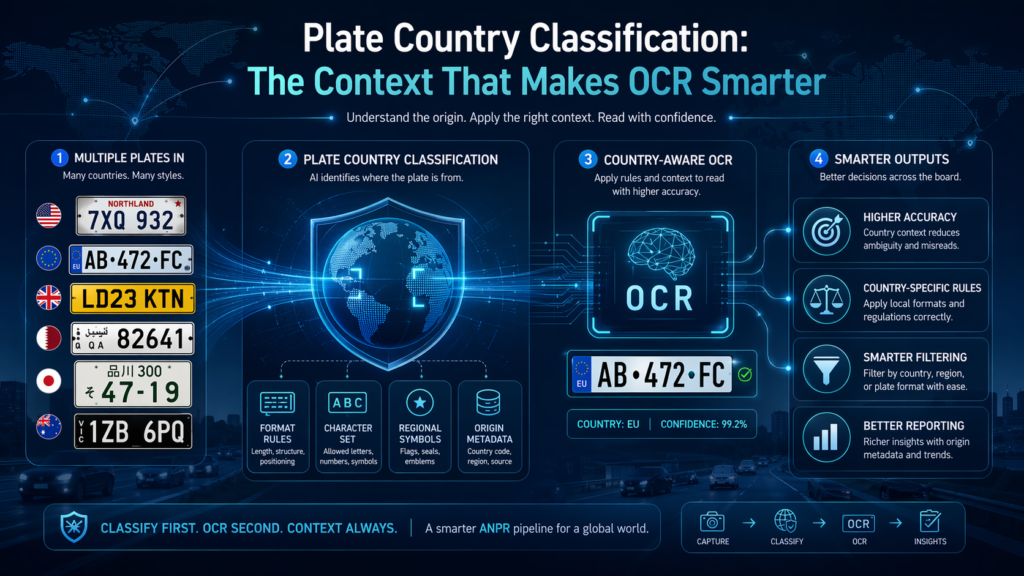
Why Context Changes Everything
Most license plate recognition systems are trained and tuned for the country they’re deployed in. The moment a plate from somewhere else enters the frame, accuracy drops — sometimes quietly, sometimes catastrophically. Character sets overlap but don’t match. Expected lengths differ. Visually similar glyphs get confused. Format validation rules that protect accuracy in one country actively hurt it in another.
Classifying the plate’s country of origin first, and then applying country-specific recognition logic, closes that gap. The OCR engine can lean on the right character set, apply the right format constraints, and resolve ambiguities using rules that actually match the plate in front of it. What used to be a source of errors becomes a source of accuracy.
This matters even in deployments that don’t consider themselves “international.” Border regions, logistics corridors, ports, tourist areas, and major highways all see a steady mix of foreign plates. So do residential complexes, industrial parks, and parking systems in cities with significant cross-border traffic. The question isn’t whether foreign plates will appear — it’s whether the system will handle them gracefully or produce silent errors nobody notices until they matter.
What It Unlocks Beyond Accuracy
Country classification isn’t just an accuracy mechanism. It’s a piece of structured metadata attached to every read, and that metadata has operational value of its own.
Operators can search and filter records by country of origin, not just plate number. Reports can break down traffic, dwell time, or violations by country — useful at border crossings, toll systems, logistics hubs, and municipal platforms trying to understand who actually uses their infrastructure. Security teams get an immediate awareness signal when foreign plates appear in sensitive zones. Access control systems can apply different rules to different origins where policy requires it.
None of this is possible if the pipeline only knows the characters on the plate. All of it becomes possible once the pipeline also knows where the plate came from.
Where It Earns Its Place
Country classification is most valuable in environments where plate diversity is the rule rather than the exception: international highways and toll systems, border and customs checkpoints, ports and logistics facilities, multi-country industrial operations, and municipal systems in regions with heavy cross-border movement. It’s also quietly useful in residential and parking applications in cosmopolitan areas, where foreign plates are common enough to matter but rare enough that a country-blind system will miss them in ways that are hard to diagnose.
In all of these, the module does the same thing: it gives the rest of the system the context it needs to behave intelligently.
The Bottom Line
Modern license plate recognition has moved past simply reading characters. The systems that perform best in real deployments are the ones that understand what they’re looking at — not just the text, but the type, the origin, the format, and the rules that come with it.
Plate Country Classification is one of the pieces that gets a system there. And in a market where most ANPR engines stop at the character string, it’s exactly the kind of detail that separates a solution that works anywhere from one that only works where it was trained.