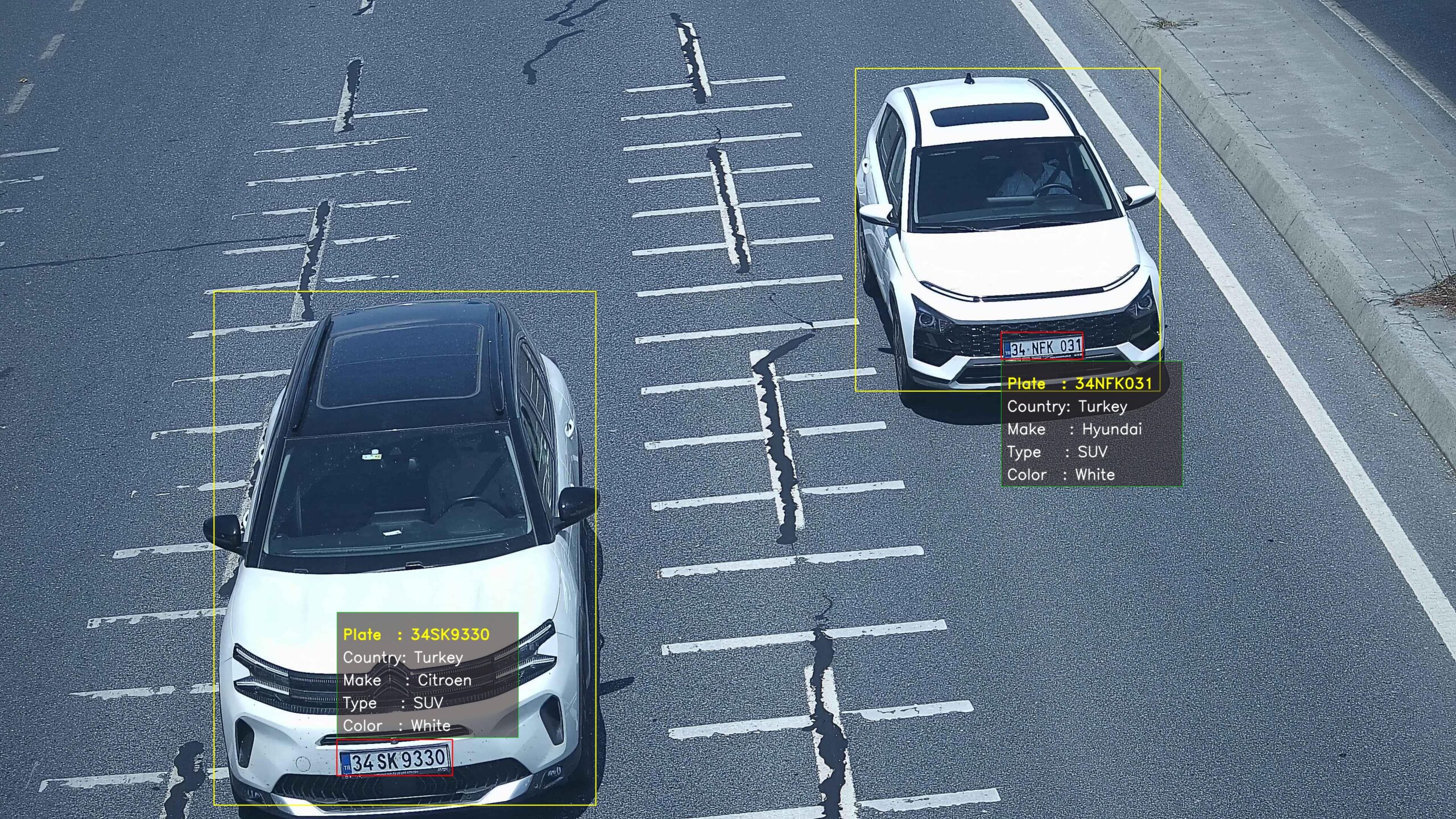
Vehicle Make, Type, and Color Recognition
In modern traffic monitoring and public safety projects, recognizing the license plate alone is often not sufficient. Today, many law enforcement agencies, municipal authorities, and public security institutions require additional vehicle analytics such as vehicle make recognition, vehicle type classification, and vehicle color recognition.
These capabilities are increasingly included in police and municipality tender specifications, especially in projects related to urban surveillance, smart transportation, traffic enforcement, public safety, access control, and forensic vehicle search systems.
By combining OCR-based plate recognition with advanced visual vehicle analytics, operators can obtain a much richer and more practical dataset for field operations.
Why Vehicle Make, Type, and Color Recognition Are Important
Traditional ANPR / LPR systems are mainly designed to read the license plate number. While this remains a core requirement, many real-world operational scenarios require additional vehicle-level information.
For example, in police, municipal, and traffic management projects, operators may need to answer questions such as:
- What is the vehicle brand / make?
- Is the vehicle a passenger car, SUV, bus, van, or truck?
- What is the vehicle color?
- Does the visual appearance match the registered or expected vehicle information?
- Can a vehicle still be filtered if the plate is partially unreadable?
This is why vehicle make, type, and color recognition have become essential complementary modules in modern traffic and security systems.
A Common Requirement in Police and Municipality Tenders
In many public sector projects, especially those related to law enforcement, municipal traffic systems, and city surveillance platforms, tender specifications increasingly require more than just plate reading.
Authorities often expect the system to provide:
- license plate recognition
- vehicle make / brand recognition
- vehicle type classification
- vehicle color recognition
- vehicle image capture
- searchable reporting and forensic filtering
These requirements are important because plate recognition alone may not always be sufficient in real operational conditions. A vehicle can be searched not only by its plate number, but also by its visual identity.
For example, operators may need to search for:
- a white SUV
- a red sedan
- a blue truck
- a Toyota, BMW, Mercedes, Ford, or Renault
- a vehicle matching both plate and appearance
This additional intelligence improves the value of the system for investigations, enforcement, and reporting.
What Vehicle Make, Type, and Color Recognition Provide
A complete vehicle analytics system can generate multiple outputs from the same scene:
- License plate number
- Vehicle make / brand
- Vehicle type
- Vehicle color
- Timestamp
- Camera information
- Vehicle image
- Event records for database and reporting
This creates a much stronger operational workflow compared to a system that only reads the plate.
How the Algorithm Works
A modern vehicle make, type, and color recognition algorithm typically works as a multi-stage computer vision pipeline.
1. Vehicle detection
The first step is detecting the vehicle in the scene. An object detection model identifies the vehicle region within the image or video frame.
2. Vehicle crop extraction
Once the vehicle is detected, the system crops the relevant region of interest. This cropped vehicle image is then passed to the classification modules.
3. License plate detection and OCR
In parallel, the license plate region can be detected and read using OCR-based recognition. This allows the system to combine visual vehicle data with plate information.
4. Vehicle make recognition
A dedicated classification model analyzes the vehicle crop and predicts the brand / make of the vehicle, such as Toyota, BMW, Mercedes, Ford, Renault, Hyundai, Fiat, Volkswagen, and many others.
5. Vehicle type classification
Another classification model determines the vehicle type, such as:
- passenger car
- SUV / Jeep
- van / minibus
- bus
- truck / TIR
6. Vehicle color recognition
The system also classifies the dominant visible color of the vehicle, such as:
- black
- white
- gray
- blue
- red
- green
- yellow
7. Result fusion and database recording
Finally, all outputs are combined into a single event record. This record can be stored in the database and used for:
- real-time alerts
- historical search
- forensic filtering
- operational reports
- smart city dashboards
Why a Multi-Stage Architecture Matters
A high-quality vehicle analytics system usually performs better when the problem is divided into specialized stages rather than trying to solve everything in a single step.
For example:
- one model can focus on vehicle detection
- another on OCR / plate recognition
- another on vehicle make
- another on vehicle type
- another on vehicle color
This modular design provides several advantages:
- better accuracy
- easier optimization
- easier retraining for local datasets
- better control over field performance
- easier integration into existing software platforms
This is especially important in public-sector projects where accuracy, reporting, and maintainability are critical.
Real-World Challenges
Vehicle make, type, and color recognition can be challenging in field conditions due to:
- low-resolution images
- night scenes
- glare and reflections
- motion blur
- poor camera angle
- occlusions
- weather effects
- similar-looking vehicle models
- dirt or visual distortion on the vehicle body
Because of this, successful systems must be trained and validated using real operational data from actual traffic and surveillance environments.
Why These Features Improve Public Safety Projects
For police departments, municipalities, and security operators, these recognition modules provide much stronger operational value.
They can support:
Faster forensic search
Even if the full plate is not available, operators can search by:
- vehicle brand
- vehicle color
- vehicle type
Better incident verification
A plate match can be checked against the visual identity of the vehicle.
Improved reporting
Authorities can generate reports based on traffic composition, vehicle classes, and vehicle appearance.
Stronger enforcement workflows
Suspicious vehicles can be filtered more effectively using multiple attributes.
Better smart city integration
Vehicle analytics can feed traffic platforms, urban monitoring systems, and public safety dashboards.
Industrial Cortex Approach
At Industrial Cortex, we focus on building practical vehicle analytics solutions for real-world deployments. We believe that modern public safety and smart traffic systems should go beyond plate reading and provide a richer set of information for operators.
Our approach combines:
- OCR-based license plate recognition
- vehicle make recognition
- vehicle type classification
- vehicle color recognition
- database recording and reporting
- integration-ready software architecture
This makes the system more useful for law enforcement, municipal traffic systems, city surveillance projects, parking platforms, and security applications.
Conclusion
Vehicle Make, Type, and Color Recognition are becoming increasingly important in modern traffic monitoring and public safety systems. In many police and municipality tender specifications, these features are no longer optional, but expected system capabilities.
By combining license plate recognition with vehicle brand, vehicle type, and vehicle color analysis, operators can achieve stronger filtering, better verification, improved reporting, and more effective field operations.
For projects where accuracy, searchability, and operational intelligence matter, these modules significantly increase the value of the overall system.